


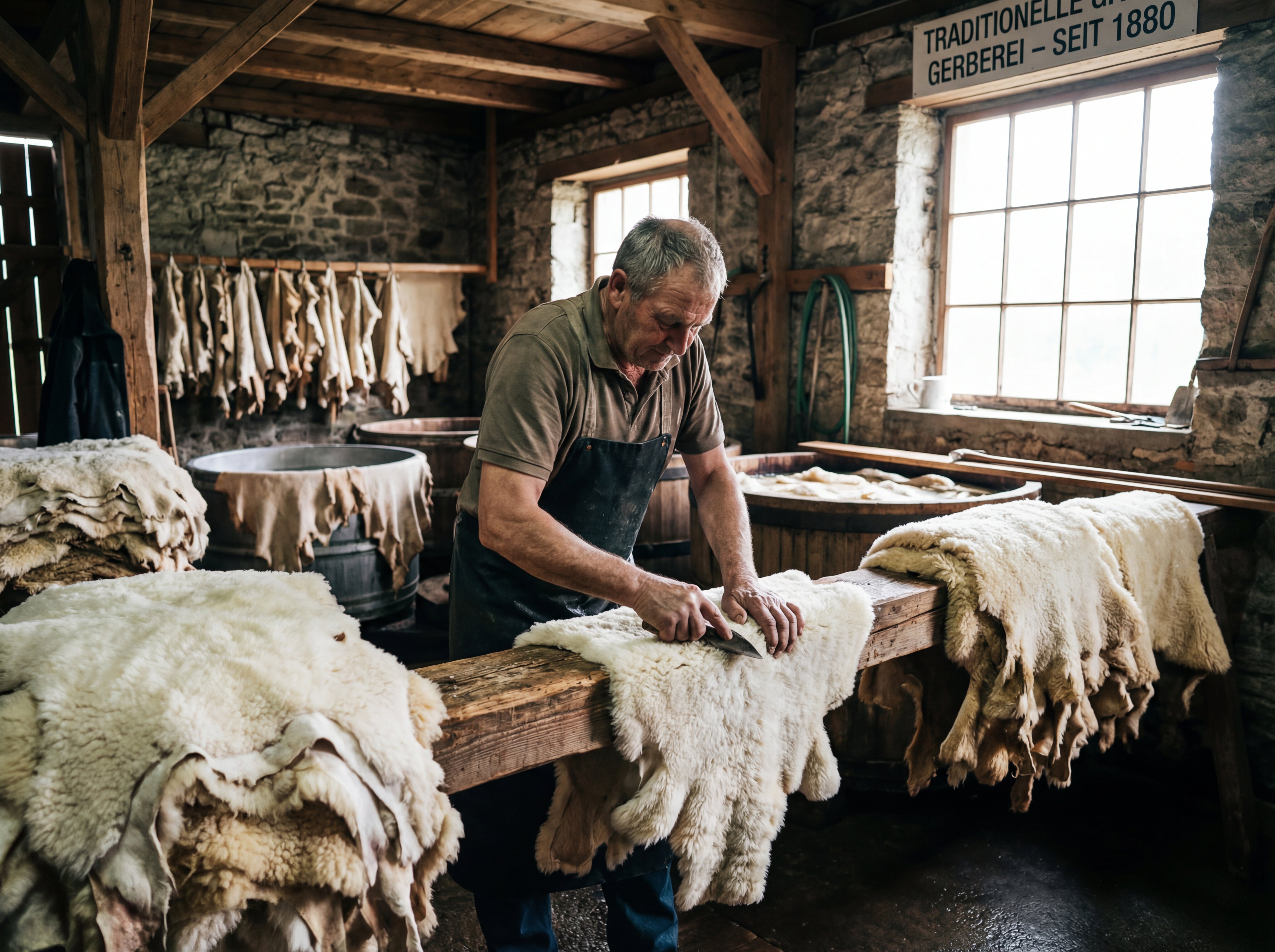
Lambskin is a natural product that is created in several steps. Here you will find out where the skins come from, how they are finished and how they become a cushion, a seat pad or a sheep stool.
Where lambskin comes from
Lambskins and sheepskins are a by-product of sheep farming. No animal is kept for its skin. The skins come from the meat and wool industry and would be discarded without tanning. Our sheepskins come mainly from Germany and Iceland, Tibet-Locki from Tibet. The type of fleece a stool has is given in its fact sheet.
Selection
Not every skin is suitable. Stools and seat pads need dense, even skins without thin patches. For cushions, softness matters most. The selection determines the durability and appearance of the finished piece.
Tanning
Tanning turns the raw hide into soft, durable leather. Cleaning, bating, tanning, oiling and drying follow one another. You can read exactly how this works in the article How is sheepskin tanned?.
Finishing
After tanning, the wool is combed and, if needed, sheared or dyed. Natural colours such as white, beige, grey, brown and black remain undyed. Coloured sheepskins are dyed with dyes approved for leather and wool.
Making the stool
For a sheep stool, the craftsman cuts the fleece to size, pads the wooden body and covers it so that no seam is visible. Head and horns are carved from solid lime wood, the surfaces stained and varnished. Finally, the brass bell goes around the neck. Around 5 to 8 hours of handwork go into each stool, and because every fleece is different, no two stools are alike.
Quality control
Before shipping, every piece is checked: is the fleece taut, are the wood and feet sturdy, is the bell secure? Only then does the stool set off, with a fleece brush and floor protectors in the parcel.
Share:
The best tips for caring for sheepskin
Interior ideas with a sheep stool: dining table, coffee table, desk